Problems with Meritocracy
More than just reform is needed - the problems are intrinsic to the ideology
Harvard professor Michael Sandel’s most recent book is about meritocracy: The Tyranny of Merit: Can We Find The Common Good? He is in a good position to observe the effects of the ideology of meritocracy, given his position teaching in an institution that could be considered the belly of the beast, the Mecca of all those seeking advancement under that ideology. I haven’t read the book yet, but recently read this interview with Sandel about what he argues in the book. It got me thinking about some of the discussions I’ve had with people over the years whenever I’ve made similar critiques of meritocracy.
One objection to critiques that often arises is to defend merit: “You wouldn’t want a surgeon to perform your surgery who wasn’t qualified” such objections argue. But this is to confuse merit with meritocracy. I have no complaint with requiring qualifications for being able to do things that require a degree of skill, expertise, etc. That isn’t the problem. The problem is the “-ocracy” part. That part refers to putting those people with the most “merit” above everyone else in power, status, and wealth. “Rule by the best” is pretty much the literal meaning of aristocracy, which meritocracy was meant to replace. Ironically, however, it has virtually the same meaning, except rather than requiring a belief that people are better, and therefore worthy of being the ruling elite just because they were born into the elite families, we end up believing that people are better because they do well in school, and on standardized tests - which we know to be closely correlated to being born in families with the resources to guarantee high degrees of this sort of “merit” to their children.
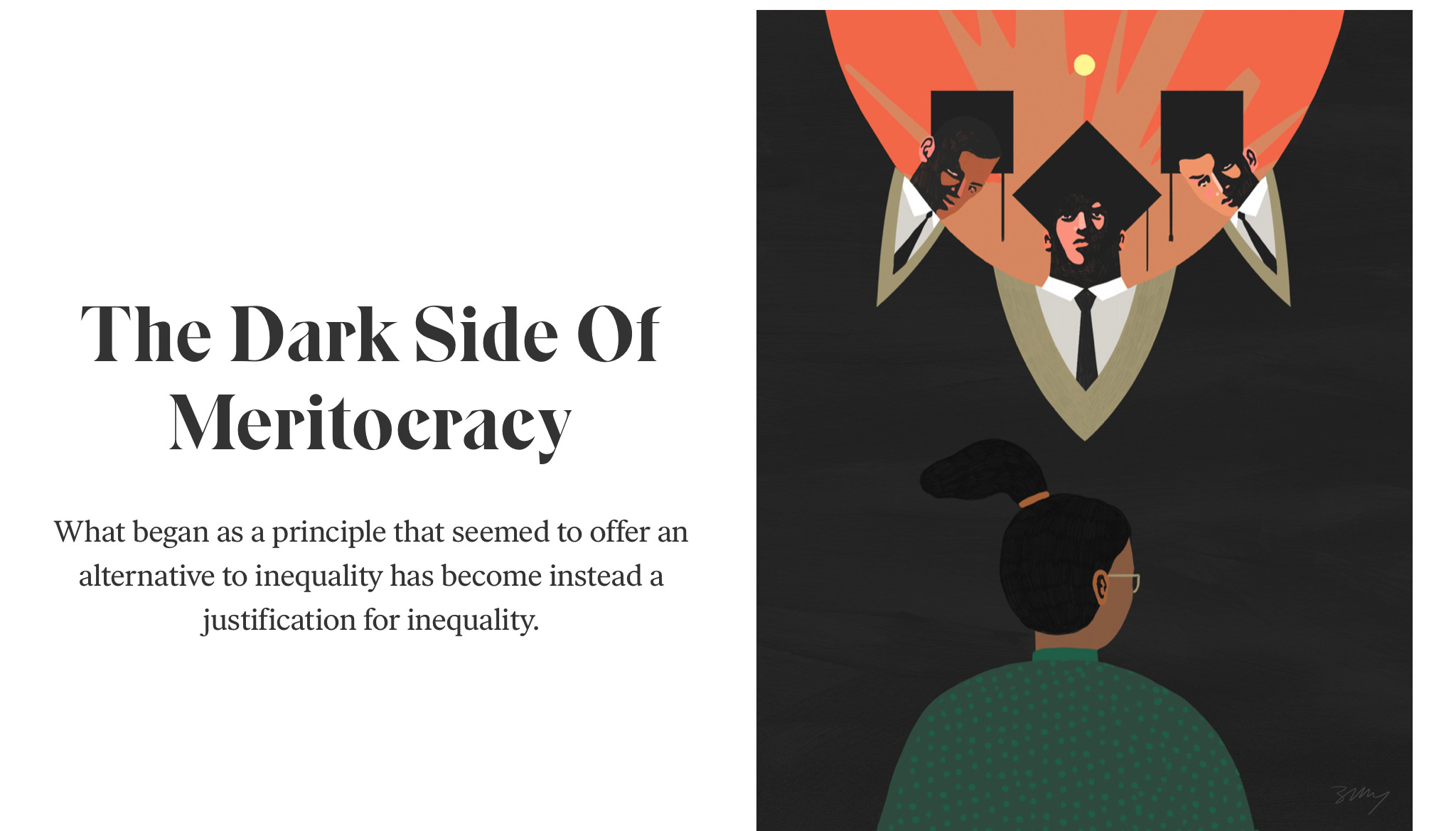
Defenders of meritocracy will usually acknowledge that the system is flawed, but often only because of corrupt practices such as big donations to elite colleges to advantage children’s admission chances, etc. But all such problems could be fixed and the key problems would still remain. First is the problem of what we believe about deservingness. To me, this is the biggest poison of the ideology of meritocracy. It’s ironic that some wealthy people complain about their tax money being spent on what they call “entitlements.” It is as if it is the poor who feel too “entitled.” Yet, it is the winners in the meritocracy game who are guilty of the worst sort of entitlement. People who indeed work hard, but no harder than a custodian, construction worker, nurse, etc. yet make thousands of times more money, fully believe they deserve all that money (and the disproportionate power and influence in the society that come with it). Meritocracy also makes them believe that the “losers” in the society deserve their fate as well, and so oppose public resources being spent on guaranteeing a dignified life for all, as that would violate the reward and punishment system in which they have done so well. So meritocracy, it seems, has gone from a purported solution to inequality to a justification for it.
Another huge societal problem is the mismatch between “merit” and the actual qualifications needed by those who would run the society well. Doing well at the merit-earning competition is a very specific type of thing which doesn’t correspond well with being good at much else. In my experience as a high school teacher, I found there were many students with the potential for the kind of wisdom, compassion, and common sense I would want in people given responsibility for working out public policy decisions - those were not necessarily the same students as those winning the merit game. The correlation between those sorts of leadership traits and the ones that would propel them the highest in the contest over merit seemed rather random. The sort of grade-grubbing, resumé-padding, competitive ruthlessness that was cultivated in those striving hardest to go highest did not bode well for the kind of public-spiritedness or integrity we might want them to have as a decision maker once in a position of power. As a society, we have experienced one elite failure after another in recent decades, with disastrous decisions and policies put in place by those with the most “merit” of this narrow sort. It isn’t so surprising this is the case once you look closely at what is demanded in order to compete successfully in this system.
Another problem is meritocracy’s anti-democratic effects. When getting credentials at elite institutions of higher education becomes the test for power, status, and wealth in the society, then most people will obviously be disempowered and devalued. Democracy ought to mean we trust in the outcome of a society-wide discourse among all our citizens. In order for all to participate, everyone needs the leisure time and the means to inform themselves, as well as the institutions in which they can participate. Instead, we treat the large majority of our citizens, those without a college degree, as subjects rather than citizens, with our elites often scolding them like children who just need to be quiet and listen to their “betters.” This goes a long way to explaining the high degree of mistrust that exists of institutions in this country. It also is an incredible waste of talent and perhaps original thinking, made even more necessary given the narrowing of thought that can also happen to elites all following similar paths through a small number of elite institutions.
Finally, the ideology of meritocracy does great damage to education. Given that education has become the key method for determining merit, it becomes merely a means to separate out students into layers of worthiness. Students sense this even when other stories are told to them about the purpose of education, such as self-discovery, learning to think critically to be a good participant in democracy, etc. What we say explicitly gets swamped by the way the system is structured and how things are done that contradict those more idealistic stories. When IB and/or AP students are given privileges and treatment that students in “lower” ranking programs are not; when assemblies are held to give ice cream or awards to the straight-A students while others have to remain in class; when teachers yell at students that they’ll end up flipping burgers if they don’t do their homework assignments; all these and more mundane daily routines demonstrate for all that school’s primary task is as a sorting mechanism for the meritocracy.
For teachers who love teaching with other ends in mind, it makes for a constant battle with compromise, with the meritocratic goals always prevailing if it comes to a showdown. I found this out quite clearly when pushing for one course (the International Baccalaureate course Theory of Knowledge) to be offered as a non-graded course. When presented with all the benefits for students’ learning that could accrue as a result of such a policy experiment, administrators concurred, without being able to articulate any clear countervailing costs. Yet, I could never get any acquiescence for even trying it. The administration failed to articulate a coherent rationale, but it was clear to me that it was just too dangerously radical to exempt this course from the competitive game upon which the whole system rested. The contrast would make too obvious the damage we were doing to students in all their other courses that stayed within the confines of the competition. For so many teachers and their students, then, school loses the possibility of being an exciting exploration of ideas and learning, and instead is a series of chores to do and hoops to jump through in a competition for ever scarcer credentials.
Sandel, in his interview, advocates for different admissions systems for elite schools, such as admission by lottery for all who meet certain qualifications. I’m fine with that, but I’m sure he would agree that would not go nearly far enough to solve the problems. As he points out in discussing the dignity of work, we need a radical change in values. We seemed to be heading in the right direction early in the pandemic with some recognition of the value of what we then referred to as “essential workers”. The people who transport and stock our groceries, cook food, care for the sick, etc., were at least rhetorically being recognized for their important roles. But alas, there have been no real changes in the structure of pay or working conditions, nor have we guaranteed decent lives (health care, housing, education, child care, etc.) for such workers who are struggling as ever to live decently, while those at the top of the meritocracy work from home (or wherever they choose) and have made bigger gains than ever in terms of corporate profits while everyone else struggles. Truly democratic values would mean valuing everyone’s voice and life, regardless of their education or expertise, with all deserving of dignity and respect and the necessities for living a decent life, which our incredibly wealthy society could easily provide for all.